

Kids & Baby Tools
Simple, friendly calculators and trackers for every stage of growing up.
Explore ToolsUltimate Baby & Kids Calculators: Growth, Health, and Learning Tools
It is 2 a.m., and you are trying to remember when the last feeding was. Or maybe you are sitting in a waiting room, wondering how your toddler’s height compares with the chart the nurse mentioned. Parenting comes with a steady stream of small questions, and keeping track of everything in your head is hard.
That is why many parents look for baby and kids calculators, trackers, and tools. Having numbers, dates, and routines in one organized place can make everyday decisions feel a little calmer. It can also help you prepare better questions for your child’s doctor.
due-date-cal.com is a collection of free baby and kids calculators, trackers, and educational tools. This article walks you through all 34 of them, grouped into four categories: pregnancy and newborn essentials; baby growth, health, and nutrition; toddler and kids health and growth; and fun learning and math calculators for kids.
A quick note before we start. These tools offer general, educational information based on what you enter. They are meant to help you organize and understand, not to diagnose or replace the guidance of your pediatrician. Children also develop at different rates, and the CDC offers a helpful overview of developmental milestones if you want to learn more about what many children do at different ages.
Explore Our Complete Baby & Kids Calculator Collection
Think of this collection as a toolbox for the whole journey, from the first weeks of pregnancy to the school years. Some tools help you plan and prepare. Others help you keep a record of feedings, sleep, or growth. A final group is designed for children to explore math and science, with a parent nearby to guide them.
You do not need to use every tool. Pick the ones that match your family’s stage and questions right now, and come back to the others when you need them.
Pregnancy & Newborn Essentials
The weeks before and after a baby arrives are full of preparation. There are names to think about, bags to pack, and a whole new routine to learn. The tools in this category help you organize those early tasks.
We have split this group in two. The first four tools are for pregnancy, and the last two are for the newborn period.
Pregnancy Tools
These tools are for expecting parents who want to prepare, plan, and feel more connected to the pregnancy.
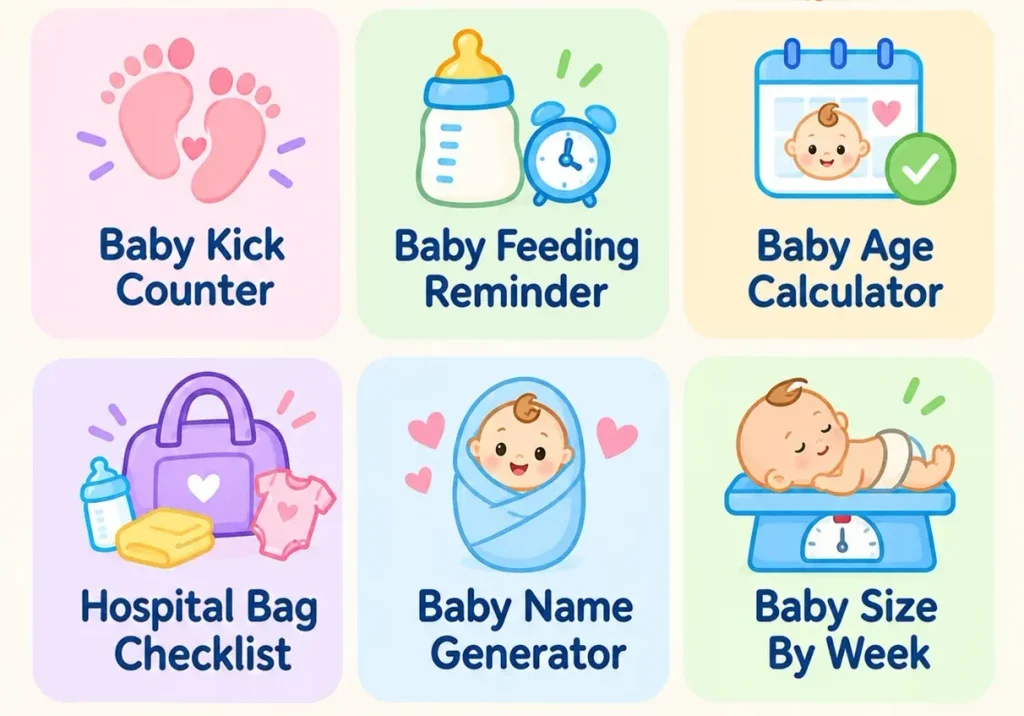
Baby Name Generator
Choosing a name can be exciting and surprisingly stressful. This tool offers name ideas to spark conversation with your partner or family, especially when you feel stuck. Treat the suggestions as a starting point, since the final choice is a personal one.
Baby Kick Counter
Many expecting parents like to notice and record their baby’s movements. This tool gives you a simple way to count kicks and keep a record. It is for your own awareness only. If you notice a change in your baby’s movement or feel worried, contact your healthcare provider right away.
Hospital Bag Checklist
Packing for the hospital or birth center is easier when you are not relying on memory. This checklist helps you gather items for yourself, your partner, and your baby ahead of time. Every family’s needs differ, so adjust the list to your own plans and your care team’s advice.
Baby Size By Week
Curious how big your baby is this week? This tool shows a general size comparison for each week of pregnancy. It is a fun way to follow along, but babies vary, so the comparison is only a rough, informational guide.
Newborn Tools
Once your baby is born, the focus shifts to daily care. These two tools help you stay on top of early routines and understand your baby’s age.
Baby Feeding Reminder
Newborn days often blur together, and it can be hard to remember when you last fed your baby. This reminder tool helps you keep feedings on your radar. Babies feed on their own rhythms, so follow your baby’s cues and your pediatrician’s guidance.
Baby Age Calculator
A baby’s age matters for many things, such as checkups, feeding stages, and tracking growth. The Baby Age Calculator works out your baby’s age from their date of birth, which is handy when someone asks how old your baby is in weeks or months. Accurate dates give the most useful result.
Baby Growth, Health & Nutrition
Once your baby is here, you may want to follow how they are growing and settling into routines. The tools in this category cover planning, growth tracking, feeding, sleep, and diapers. They are meant to support organization and awareness, not to give personal medical recommendations.
A few things are worth keeping in mind as you use them. Every baby has individual needs, and growth, feeding, and sleep patterns vary widely among healthy babies. If a result leaves you unsure, bring your notes to your pediatrician instead of trying to interpret them alone.
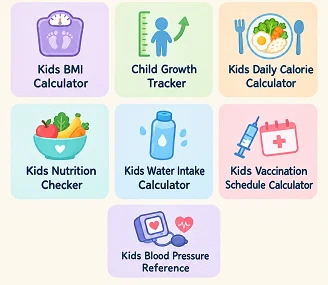
Many parents search for a baby growth calculator, a baby percentile calculator, or an infant weight chart. Our percentile tools below are the closest match, and they are designed to help you see how your baby’s measurements compare with a reference group. For context, the WHO’s Child Growth Standards are the reference for how healthy children are expected to grow in ideal conditions. CDC guidance generally recommends WHO growth standards for children under 2 years and CDC growth charts for ages 2 to 19 years.
Baby Budget Calculator
Babies bring new expenses, from diapers and clothing to medical visits and childcare. This planning tool helps you organize and estimate family costs so surprises are fewer. It is a money-management aid, not a health tool, and your results depend on the numbers you enter.
Baby Weight Percentile
A percentile compares your baby’s weight with a reference population of babies of the same age and sex. This tool is useful when you want to understand what a number from a checkup means. A percentile alone does not tell you whether a baby is healthy, so your pediatrician looks at the full picture.
Baby Teething Chart
Teething can start at different ages, and it often raises questions about which tooth is coming next. This chart gives a general overview of when baby teeth commonly appear. Timing varies a lot from child to child, so use it as a loose guide and ask your dentist or pediatrician about concerns.
Breastfeeding Tracker
Keeping a record of nursing sessions can help when you feel too tired to remember details. This tracker lets you note feedings so you can spot your own routine and share it with a lactation consultant or pediatrician if needed. It does not judge how well feeding is going.
Baby Sleep Tracker
Sleep patterns change quickly in the first year, and it helps to see them written down. Use this tracker to log your baby’s naps and nighttime sleep, then look for patterns over several days. Sleep needs differ among babies, so the log is for awareness, not for comparison.
Baby Diaper Tracker
Wet and dirty diapers are one of the things pediatricians often ask about. This tracker helps you record them so you do not have to guess at an appointment. If you have concerns about your baby’s diapers, talk to a healthcare professional.
Baby Height and Weight Percentile
Sometimes it helps to look at length and weight together instead of one measurement alone. This tool compares both against a reference population, which can make your baby’s checkup numbers easier to understand. As with any percentile, it is a comparison and not a verdict on your baby’s health.
Baby Height and Head Circumference Percentile
Head circumference is a measurement your paediatrician usually takes in the early years. This tool compares your baby’s length and head measurements with reference data. It is meant for general understanding, and any questions about the results should go to your child’s doctor.
Baby Solid Food Planner
Starting solids is a big step, and many parents like to plan. This planner helps you organise what you want to introduce and when. Your paediatrician can tell you when your baby is ready and which foods to offer, especially if allergies run in your family.
Baby Formula Quantity
Parents who use formula often wonder how much to prepare. This tool gives a general estimate based on the details you enter. It is not a personal feeding recommendation, so follow your pediatrician’s advice and the instructions on your formula’s label.
Toddler & Kids Health & Growth Tools
As children move past the baby stage, parents often find themselves asking new questions about growth, eating, hydration, and checkups. The tools in this category are meant to help you organize information and learn more about general reference values. They are educational, and none of them gives personal medical advice.
For children aged 2 to 19 years, CDC guidance points to the CDC growth charts as the standard reference. Remember that a chart or calculator only shows a comparison. Your child’s doctor looks at height, weight, health history, and family patterns together.
Child Growth Tracker
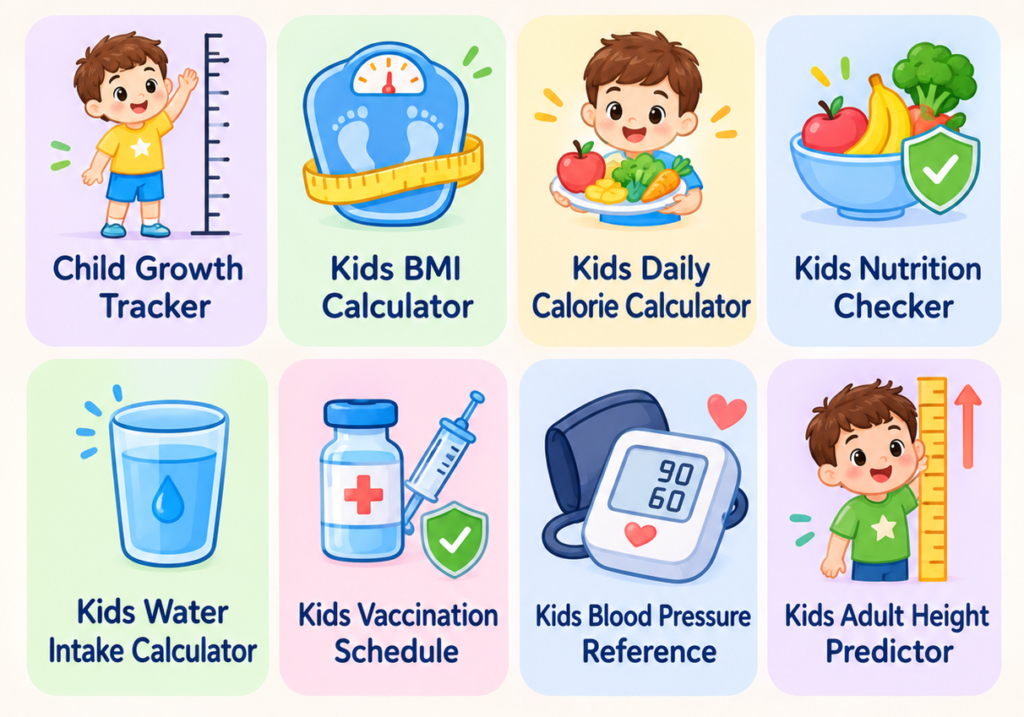
Growth is easier to understand over time than in a single snapshot. This tracker helps you keep your child’s measurements in one place so you can see how they change between checkups. It works best when you enter measurements carefully, and any worries about the pattern belong with your pediatrician.
Kids BMI Calculator
BMI uses height and weight to produce a single number. In children, that number is only meaningful when compared with other children of the same age and sex, so it is not read the way adult results are. Use this tool to learn about the measurement, and let your child’s doctor explain what it means for your child.
Kids Daily Calorie Calculator
Parents sometimes wonder how much energy a growing child needs in a day. This tool offers a general estimate based on the details you enter. Children differ in activity, growth spurts, and appetite, so treat the result as a rough reference and not as a diet plan.
Kids Nutrition Checker
Busy days can make it hard to tell whether a child’s meals are well balanced. This checker gives you a simple way to look at what your child eats and think about variety. It is an educational aid only, and your pediatrician or a registered dietitian can guide you on specific food needs, allergies, or picky eating.
Kids Water Intake Calculator
Hydration needs shift with age, weather, and how active a child has been. This calculator offers a general idea of daily fluid intake based on the information you provide. It cannot account for every situation, so ask your child’s doctor if you are unsure, especially during illness or very hot days.
Kids Vaccination Schedule Calculator
Keeping track of vaccine dates can feel like a lot to manage. This tool helps you organize and view a general schedule so you can plan ahead for appointments. Schedules can vary by country and by a child’s health history, so follow your pediatrician’s or local health authority’s advice.
Kids Blood Pressure Reference
Blood pressure in children is judged differently from adult blood pressure, and normal ranges depend on age, sex, and height. This reference helps you become familiar with general values. It cannot tell you whether your child’s reading is a concern, so please talk with a healthcare professional about any measurement.
Kids Adult Height Predictor
Many parents and children enjoy wondering how tall a child might become. This tool gives a rough estimate of adult height from the details you enter. It is a fun, general guess and not a promise, and it says nothing about your child’s future health or development.
Fun Learning & Math Calculators for Kids
Not every tool on the site is about health. This last group is for children who enjoy numbers, puzzles, and science. A parent or caregiver nearby makes these tools more fun, and short, relaxed sessions often work better than long ones.
These activities are meant to encourage curiosity and practice. Every child learns at their own pace, and teachers can offer the best guidance on schoolwork.
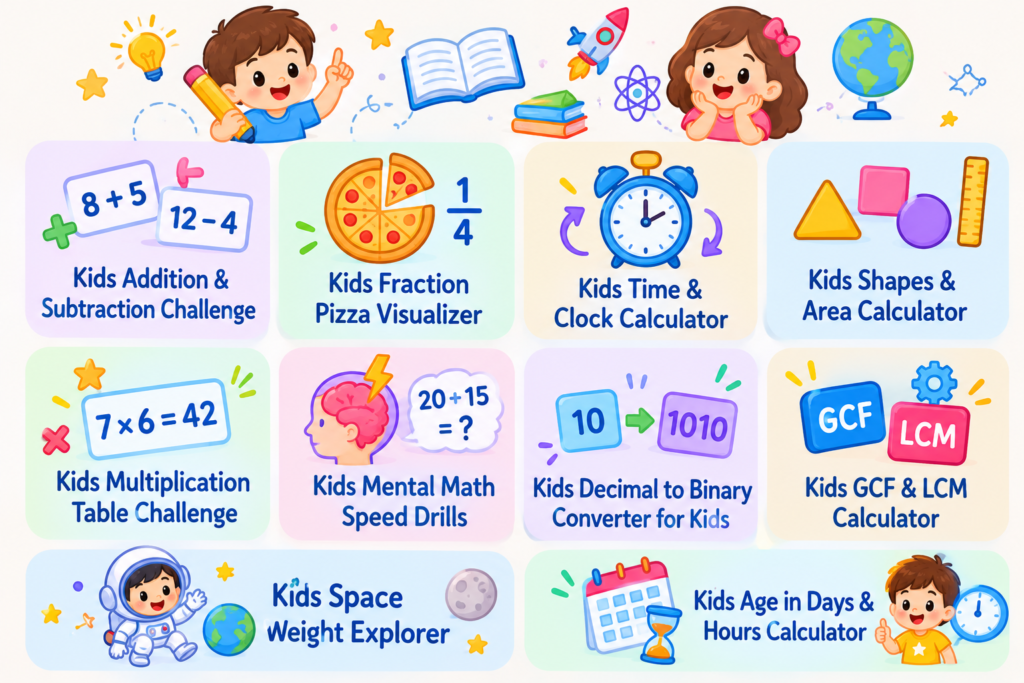
Not every tool on the site is about health. This last group is for children who enjoy numbers, puzzles, and science. A parent or caregiver nearby makes these tools more fun, and short, relaxed sessions often work better than long ones.
These activities are meant to encourage curiosity and practice. Every child learns at their own pace, and teachers can offer the best guidance on schoolwork.
Kids Addition & Subtraction Challenge
Basic arithmetic becomes easier with regular, low-pressure practice. This challenge gives children addition and subtraction problems to work through at their own speed. It is a friendly way to build confidence, and you can cheer them on even when an answer is wrong.
Kids Fraction Pizza Visualizer
Fractions can be confusing until a child sees them as slices of something familiar. This visualizer uses a pizza to show how a whole is divided into equal parts. It can make a good starting point for talking about halves, quarters, and sharing.
Kids Time & Clock Calculator
Reading clocks and working out how much time has passed are skills children pick up gradually. This calculator helps them explore hours and minutes, such as how long until dinner or how long a movie lasts. Sit with younger children so you can talk through the answers together.
Kids Shapes & Area Calculator
Shapes are everywhere, from windows to rugs to playgrounds. This tool lets children explore common shapes and find their area. Try pairing it with real objects in your home so the numbers feel connected to something they can see and measure.
Kids Multiplication Table Challenge
Multiplication tables take repetition, and a challenge format can keep that repetition from feeling dull. Children can test themselves on times tables and notice which ones they already know well. Encourage steady practice instead of speed, since confidence usually comes first.
Kids Mental Math Speed Drills
Some children enjoy racing the clock, and quick drills give them a way to practice doing sums in their heads. This tool offers timed practice for children who like that kind of challenge. If your child feels stressed by timers, slow down and focus on getting answers right.
Kids Decimal to Binary Converter for Kids
Computers store information using only two digits, and this converter shows children what ordinary numbers look like in that code. It is a fun peek into how technology works, especially for curious older kids. Parents who are new to binary can explore it alongside their child.
Kids GCF & LCM Calculator
Greatest common factor and least common multiple are ideas children meet when they study fractions and number patterns. This calculator lets them enter numbers and see the results, which can help them check their own homework steps. It works best as a companion to what they learn in class, not a shortcut around it.
Kids Space Weight Explorer
How much would you weigh on the Moon or on Mars? This explorer lets children imagine their weight on other worlds, turning science into a playful guessing game. It is a good conversation starter about gravity and planets, and a nice excuse for a late-evening stargazing chat.
Kids Age in Days & Hours Calculator
Children love big numbers, and seeing their age in days and hours can feel surprising. This calculator turns a birth date into those units, which can spark questions about time and counting. It also makes a fun birthday activity, and the result depends on the date entered.
Why Parents & Kids Love Our Free Tools
Parents tell us, in many different ways, that they want things to be simple. The tools on due-date-cal.com are designed around that idea, and all of them are free to use.
Here are some of the benefits families can expect:
- Convenient access to parenting and educational tools in one place, whether you are on a phone at an appointment or on a laptop at home.
- Results that are easy to read, without medical jargon.
- Support for everyday organization, from feedings and sleep to expenses and checklists.
- Help keeping information together over time where a tool supports it, so you can bring notes to your child’s doctor.
- Chances for children to explore math and science in a playful way.
- Many related calculators in one collection, so you do not need to search for a new site each time a new question comes up.
These tools are meant to inform and organize. They are not clinically validated medical devices, and they do not replace the advice of healthcare professionals.
Frequently Asked Questions
How can I track my baby’s growth at home?
The most reliable growth measurements usually come from your pediatrician’s office, where equipment and technique are consistent. At home, you can keep a record of those measurements with their dates, along with notes about feeding, sleep, and diapers. Bring that record to your next visit so your doctor can see the whole picture.
What is a baby growth calculator?
The phrase is a general search term for tools that compare a baby’s measurements, such as weight, length, or head size, with reference data. On due-date-cal.com, the percentile tools and the Child Growth Tracker serve that purpose. The results are informational and depend on the measurements you enter.
How do baby growth percentiles work?
A percentile compares a child’s measurement with a reference population of children of the same age and sex. It does not, by itself, tell you whether a child is healthy. Per CDC guidance, WHO growth standards are generally recommended for children under 2 years, and CDC growth charts for ages 2 to 19 years.
When should I talk to a pediatrician about my child’s growth?
Speak with a healthcare professional whenever you are worried about your child’s growth, feeding, development, or sudden changes in their usual patterns. You do not need to wait for a calculator to tell you something. Children develop at different rates, and your doctor can help you tell normal variation from something that needs attention.
Are baby and kids calculators a replacement for medical advice?
No. They give general educational information and help you stay organized. Only a qualified healthcare professional can assess your child’s health, growth, feeding needs, or vaccination plan.
Conclusion
Parenting is full of questions, and having a few reliable tools can make the daily routine feel more manageable. From planning for a newborn to following growth over the years to helping a child enjoy math, the baby and kids calculators, trackers, and tools on due-date-cal.com are meant to support your organization and curiosity.
Use them as a way to notice patterns, prepare for appointments, and learn alongside your child. When something feels uncertain, your pediatrician remains the best person to ask.
Explore the free baby and kids calculators on due-date-cal.com and find the tools that fit your family’s everyday needs.
Medical Disclaimer
The calculators and trackers on due-date-cal.com provide general educational and informational results only. Those results depend on the information you enter and on the methodology each tool uses.
These tools do not replace professional medical, pediatric, nutritional, or educational advice. If you have concerns about your child’s health, growth, feeding, development, or vaccination, please consult a qualified healthcare professional. The website does not provide a diagnosis through any of these tools.